
Building an AI-Ready SAP Enterprise
The journey from fragmented data to intelligent business decisions.

Over the past two years, every boardroom has had the same conversation.
"How do we adopt AI?"
Organisations have invested in copilots, machine learning, dashboards, data lakes, and GenAI initiatives. Yet many of these projects struggle to move beyond pilots.
Not because the AI isn't powerful.
Because the business data isn't ready.
Most enterprises today have data spread across SAP S/4HANA, SuccessFactors, Ariba, Concur, CRM systems, manufacturing systems, spreadsheets, data warehouses, and cloud platforms.

Every system has its own version of the truth.
Every department defines metrics differently.
As a result, AI spends more time trying to understand the business than actually helping it. This is exactly the problem SAP Business Data Cloud (BDC) was designed to solve.
AI is only as intelligent as the business context it receives
Generative AI has changed how we interact with technology.
But enterprise AI requires something consumer AI never had to worry about:
Business semantics.
When a CFO asks:
"Why has operating margin reduced despite revenue growth?"
AI cannot answer by looking at revenue tables alone.
It needs to understand:
Financial hierarchies
Profit centers
Cost allocations
Procurement
Inventory
Workforce costs
Planning assumptions
Historical trends
Business definitions
This business meaning is what SAP calls semantic richness.
SAP Business Data Cloud is built around preserving this business context rather than forcing organisations to recreate it every time they build an analytical model.
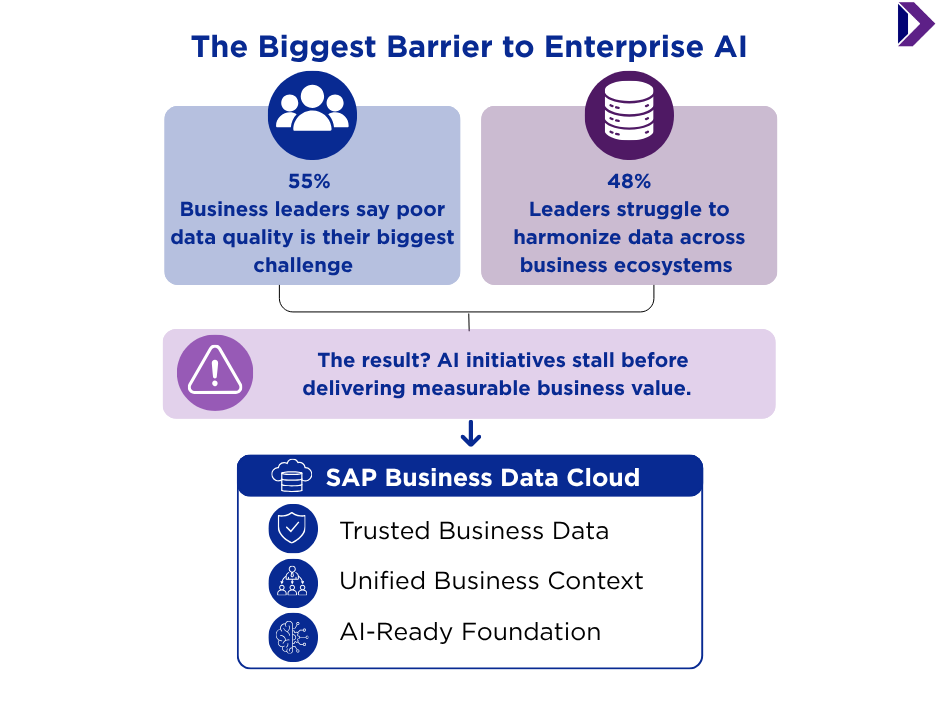
These findings highlight a challenge that technology alone cannot solve. Enterprise AI requires more than algorithms, it requires trusted business context.
When finance defines revenue differently from sales, procurement uses inconsistent supplier data, or HR operates independently from workforce planning, AI produces inconsistent recommendations because it lacks a single understanding of the business.
This is where SAP Business Data Cloud represents a significant shift. Rather than simply connecting systems, it creates a unified, governed, and business-aware data foundation that enables analytics, planning, and AI to operate on the same trusted source of truth.
From data integration to business understanding
Traditional analytics projects often spend months on:
Building ETL pipelines
Reconciling master data
Recreating business logic
Validating KPIs
Maintaining dashboards
By the time insights become available, business priorities have already changed.
SAP Business Data Cloud fundamentally changes this model.

Instead of asking customers to assemble dozens of technologies themselves, SAP provides one managed platform that combines:
SAP Datasphere
SAP Analytics Cloud
SAP BW/BW4HANA Private Cloud
SAP Databricks
Intelligent Applications
Data Products
Business Data Fabric
AI capabilities through Joule
The objective is simple:
Spend less time engineering data and more time creating business value.
The biggest innovation isn't AI
It's Data Products.
Most organisations think about data as tables.
SAP BDC thinks about data as products.
A Data Product isn't merely exported data.
It is business-ready information that already understands:
Business definitions
Relationships
Governance
Metadata
Security
Semantics
Instead of every analytics team rebuilding "Sales Order" differently, everyone consumes the same trusted business object.
The impact is enormous.
Instead of debating whose numbers are correct, organisations begin discussing what decisions to make.
Why this matters for AI
Generative AI performs dramatically better when it receives structured, governed, business-aware information.

This is why SAP has embedded AI directly into the architecture instead of treating AI as another application. BDC provides:
Governed business context
Unified semantic models
Trusted KPIs
Consistent master data
Reusable Data Products
This allows AI assistants like Joule to provide recommendations that are based on enterprise context, not internet knowledge.
Zero-copy architecture: A quiet revolution
One of the least discussed (but most important) innovations in SAP BDC is Zero-Copy Data Sharing.
Historically, organisations copied data repeatedly:
ERP → Warehouse → Analytics Platform → Data Lake → AI Platform

Every copy increased:
Storage costs
Synchronization effort
Governance complexity
Security risk
SAP Business Data Cloud eliminates much of this duplication through Delta Sharing.
Instead of moving data everywhere, systems securely access the same governed Data Products. The result is:
Lower infrastructure costs
Faster analytics
Better governance
Fresher data
Reduced technical debt
Intelligent Applications: Analytics without implementation projects
Business leaders have grown accustomed to hearing:
"The dashboard will be ready in four months."
BDC introduces SAP-managed Intelligent Applications that combine:
Data Products
Semantic models
Analytics
Planning
AI capabilities
These applications arrive preconfigured for specific business functions.
Unlike traditional business content, SAP manages:
Data integration
Updates
Lifecycle management
Enhancements
This dramatically reduces implementation effort while ensuring customers always benefit from SAP's latest innovations.

SAP Databricks brings enterprise AI into the SAP ecosystem
Many organisations have invested in advanced AI and machine learning outside SAP.
The challenge has always been governed access to ERP data.
SAP Databricks changes this.
Integrated directly into BDC, it enables organisations to:
Build ML models
Develop predictive analytics
Perform large-scale data engineering
Create AI solutions
All while securely accessing SAP business data without unnecessary replication.
For data scientists, this removes months of engineering work.
For business leaders, it accelerates innovation.
Existing investments remain protected
Perhaps the biggest misconception surrounding SAP Business Data Cloud is that it replaces existing SAP products.
It doesn't.
BDC builds upon them.
Organisations can continue using:
SAP Analytics Cloud
SAP Datasphere
SAP BW
SAP BW/4HANA
Existing SAC stories
Existing planning models
while progressively adopting the new capabilities offered by BDC.
This allows organisations to modernize at their own pace rather than through disruptive, all-at-once transformations.
The shift from reporting to decision intelligence
Traditional BI answers: What happened?
Modern AI must answer:
Why did it happen?
What will happen next?
What should we do?
What is the likely business impact?
These questions require far more than visualization.
They require trusted enterprise knowledge.
SAP Business Data Cloud provides the foundation for that knowledge.
What this means for decision makers
For CIOs, BDC simplifies an increasingly fragmented data landscape.
For CFOs, it creates a single source of financial truth across business functions.
For business leaders, it reduces dependence on lengthy analytics projects.
For AI leaders, it provides the governed, business-aware data foundation that enterprise AI has been missing.

Most importantly, it allows organisations to move beyond isolated AI experiments toward AI that is deeply connected to business processes.
The Quantum Digital Perspective
Many organisations begin their AI journey by selecting models, copilots, or automation tools.
In reality, successful AI transformation starts much earlier, with the quality, governance, and business context of enterprise data.
SAP Business Data Cloud represents a significant evolution in SAP's data and analytics strategy. By bringing together trusted business data, analytics, planning, and AI into a single managed platform, it enables organisations to shift from fragmented reporting environments to a unified foundation for intelligent decision-making.
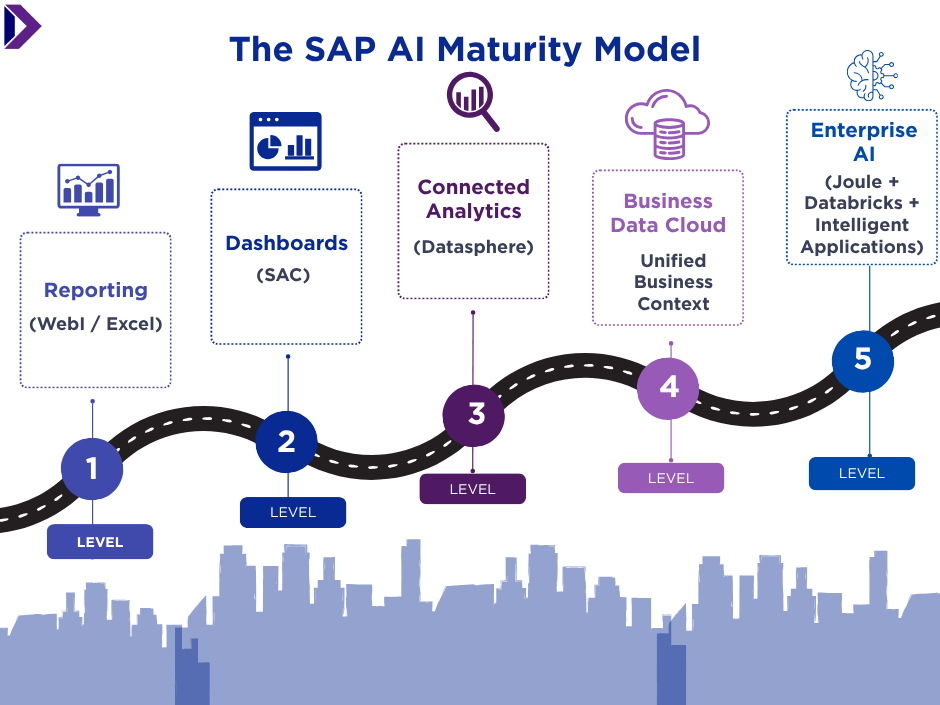
At Quantum Digital, we've already helped organisations turn this vision into reality. Our team has successfully delivered three SAP Business Data Cloud implementations across the retail, utilities, and real estate sectors, helping clients unify SAP and non-SAP data, modernise their analytics landscape, and establish a scalable foundation for AI. These engagements have enabled business users to move beyond fragmented reporting and gain faster, more reliable insights through SAP Datasphere, SAP Analytics Cloud, and SAP Business Data Cloud.
The implementation snapshots below showcase examples of these deployments, illustrating how SAP Business Data Cloud is being applied in real-world enterprise environments to solve complex business challenges.

Whether you're planning to modernise SAP BW, adopt SAP Datasphere, migrate analytics to SAP Analytics Cloud, or build an AI-ready data platform, the journey starts with a trusted data foundation. We combine deep SAP data and analytics expertise with practical implementation experience to help organisations accelerate that transformation, delivering measurable business value, not just technology.


Comments